The $0 Stripe Dashboard: How to Turn "Cool Idea" into "Paid Subscription"

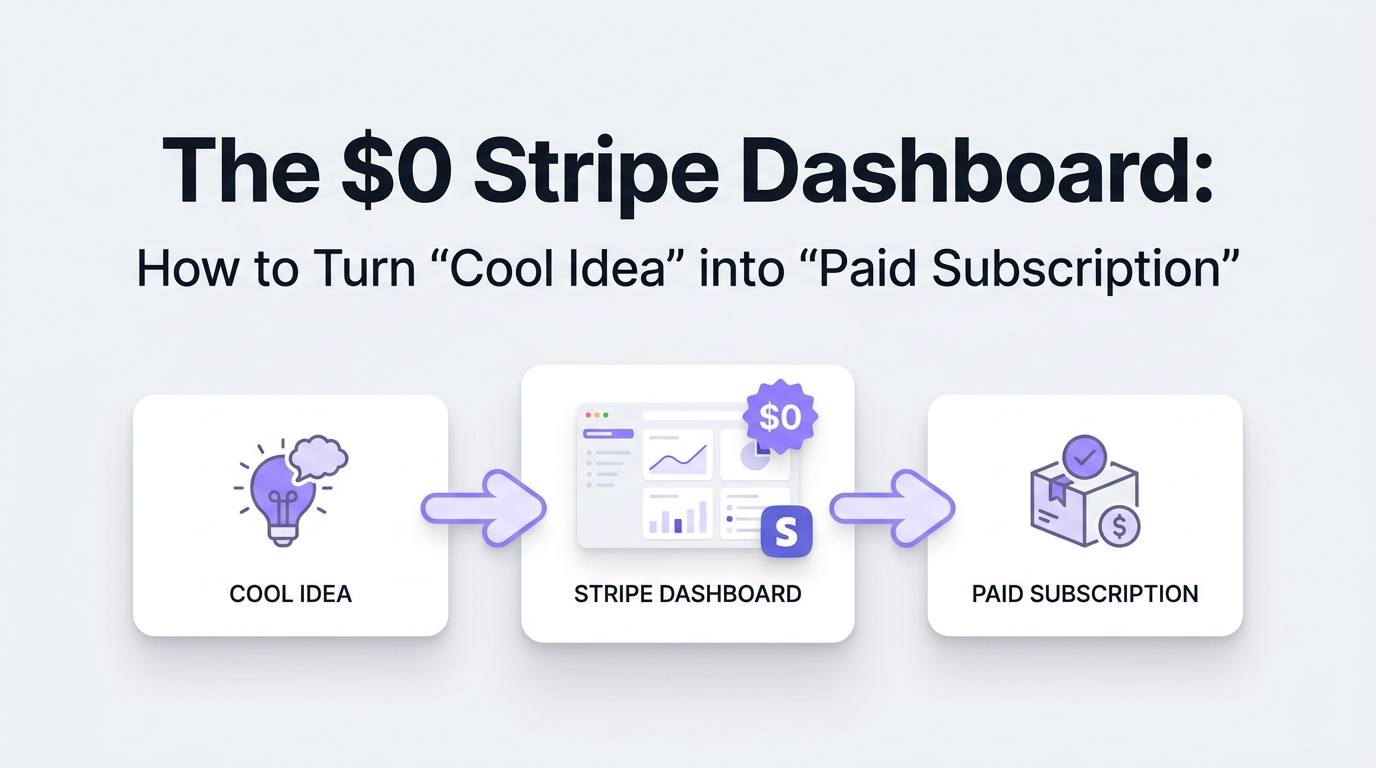
You’ve spent months in the lab. You’ve shared progress shots on social media, maybe even hit the top five on Product Hunt, and your notifications are a steady stream of "This looks incredible!" and "Great UI!"
Technically, you’ve won. People like the idea of what you’ve built.
But then you check your Stripe dashboard, and it’s a flat line. $0.
This is the "Validation Gap." It’s the psychological canyon between a stranger giving you a digital high-five and that same stranger actually reaching for their wallet. Most solo founders stall here because they fall for the most expensive lie in tech: Build it and they will come. In reality, sustainable growth requires reaching Product-Market Fit, where the market's demand actually pulls the product out of you.
Waiting for customers to find you via the "perfect" landing page isn't marketing—it’s procrastination. If you want to move from a project to a business, you have to stop seeking technical validation and start hunting for sales validation.
Here is how to bridge that gap without losing your mind (or your brand’s soul).
The False Choice: Manual Grinding vs. Spammy Automation
When founders realize they need to actually sell, they usually panic and swing between two extremes:
- The Manual Grind: Spending six hours a day scouring Reddit, forums, and niche communities, trying to find anyone mentioning a pain point. This is the fastest route to founder burnout.
- The "Blast" Method: Buying a cold lead list and spamming 5,000 people. This doesn't just fail; it actively poisons your brand before you’ve even started.
Early-stage growth shouldn’t be a choice between exhaustion and annoyance. For a solo founder, the goal is to scale your helpfulness. You can effectively scale without selling your soul by using AI to handle the heavy lifting of discovery while you focus on the human interaction.
You need a middle ground: automate the discovery of the conversation, but keep the interaction 100% human. This is exactly why we built Kuverly. We wanted to help founders monitor the right conversations in real-time so they can show up with value, not a sales pitch.
1. Put Down the Code and Start Talking
If you have a working MVP, your "technical" work is done for now. Your new full-time job is distribution.
Trust is the only currency that scales in high-intent communities. People don’t buy tools; they buy solutions from people they trust. If you’re spending more time tweaking button gradients than talking to potential users, you’re building a product for no one.
The Rule: For every hour you spend coding, spend two hours finding three people who are currently complaining about the problem your software solves. This transition from builder to marketer is the key to how solo founders get their first 10 B2B SaaS customers—by shifting from a build-centric focus to high-value industry participation.
2. Treat Comment Sections as Your Sales Funnel
We’re told the "funnel" starts with a Facebook ad and ends on a landing page. For a solo founder with a $0 budget, that’s a fantasy.
In the early days, public comment sections are your funnel. Why? Because they provide social proof and context at the same time. When you answer a question on a subreddit or specialized forum, you aren’t just talking to one person—you’re talking to the hundreds of "lurkers" who have the exact same problem.
How to do this without being "that guy":
- Skip the pitch: If someone asks, "How do I manage freelance invoices?", don't just drop a link.
- Give away the "Micro-Value": Explain a framework or a quick tip they can use right now without your tool.
- The Soft Pivot: Mention your product as the "easy way." ‐I used to do this manually using [Method X], but it got annoying, so I built a small tool to automate it. Happy to let you try it if it helps.‑
3. Scale the Search, Not the Spam
The "manual grind" is what kills most solo businesses. You can’t be on every platform 24/7.
The secret to your first 10 paying customers is semi-automated outreach. You should use tools to "listen" for intent. When someone mentions a specific keyword or pain point in your niche, you should get a ping. This is essentially leveraging intent data to ensure you are only talking to people who actually need your help right now.
Automating the search is a necessity; automating the conversation is a mistake. Your first 10 customers will come from being genuinely helpful in a thread, not from a "perfect" email sequence. By using Kuverly, you can scale that presence, ensuring you’re in the right room at the right time, without losing the human touch that actually closes deals.
4. The "Free to Paid" Pivot
If you have a base of free users but no revenue, you are likely suffering from a second-session slump. The transition to paid is about value-locking, not just "charging for what used to be free."
As you talk to people, listen for the business impact. People don’t pay for features; they pay to save time, make money, or stop feeling anxious. You need to identify the "Aha! moment"—that specific point where a user first realizes the real value of your product.
Shift your public messaging from "Look at this feature" to "This is how much time this saves." When you talk about your product in forums, frame it around the result. If your technical validation proved the tool works, your sales validation must prove the tool matters. To scale this message effectively, consider using batch content creation to keep your messaging consistent across platforms without burning out.
The Bottom Line: Founder-Led Distribution
For a one-person business, you are the brand. You don’t have the budget to outspend competitors on Google Ads, and you don’t have the time to wait two years for SEO to kick in.
You have to go where the people are, join their conversations, and earn their trust one helpful comment at a time.
Bridging the gap from validation to revenue isn't about a "Grand Launch." It’s about a series of small, human interactions. Scale your discovery, automate the "listening," and remember: if you aren't talking to your customers, you aren't building a business—you're just practicing a hobby.
Get actionable content marketing tips - straight to your inbox.
Join the Kuverly newsletter for proven strategies, fresh content ideas, and AI marketing tips. No spam, just value.