The Founder’s Guide to Winning Fragmented Markets with a Content-Led GTM

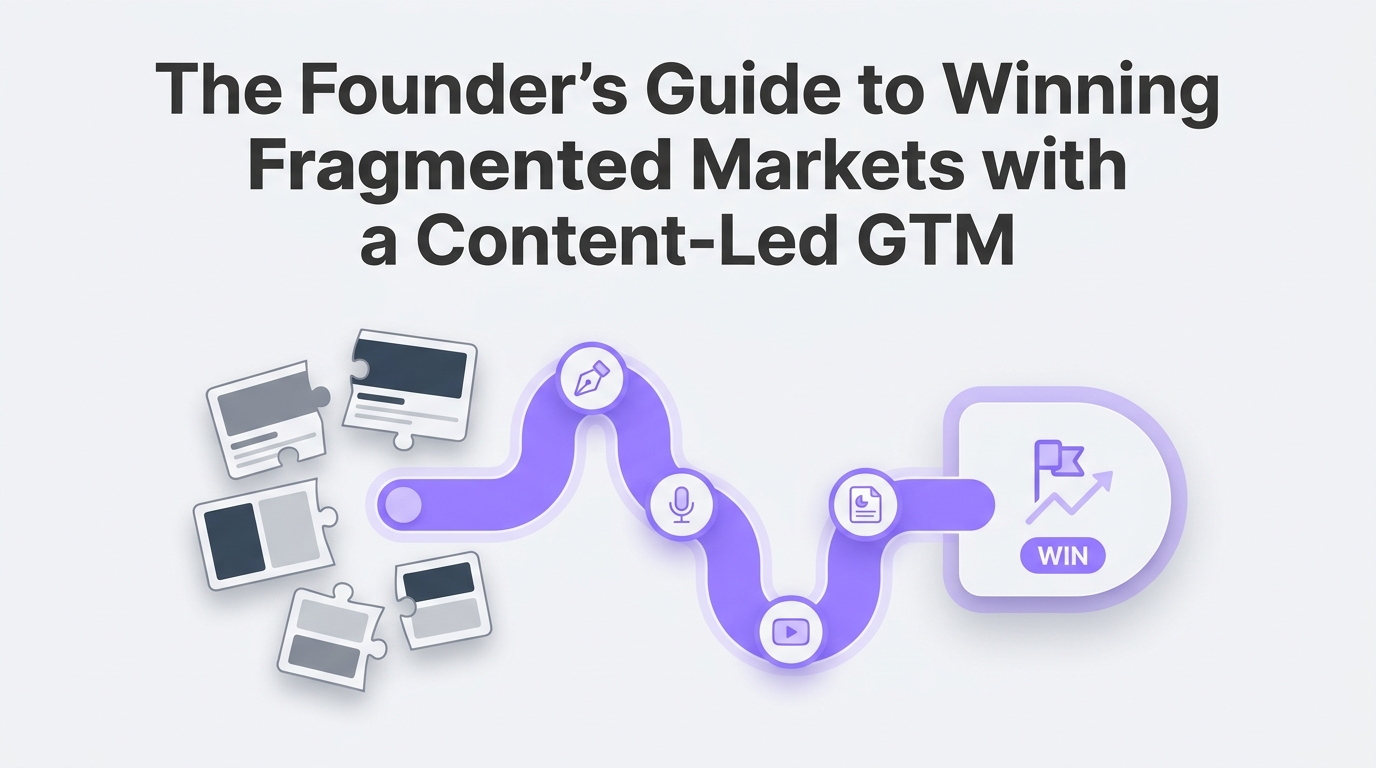
For most early-stage founders, the "build it and they will come" dream doesn’t just fade—it hits a brick wall about forty-eight hours after launch. You hit "publish" on Product Hunt, send a few tweets, and then… silence.
This silence is especially deafening if you’re entering a fragmented market.
In a fragmented market, there is no "Goliath" to take down. Instead, you’re facing a thousand "Davids"—micro-competitors, niche players, and a customer base scattered across a dozen different industries. There is no single trade show to attend or one "watering hole" where everyone gathers.
In this environment, traditional broad-scale advertising isn't just expensive; it’s a black hole for your seed funding. To win, you need to debunk common content marketing myths and embrace a strategy that establishes authority rather than just noise. You don’t need to shout louder; you need to be the most helpful person in the room.
Why Fragmented Markets Kill Traditional Marketing
In a concentrated market, you know the five keywords to bid on. In a fragmented market, your potential users are tucked away in private Slack channels, niche LinkedIn groups, or industry-specific forums.
When your audience is this scattered, trust is your only scalable currency. You can’t rely on brand recognition, so you have to rely on demonstrated expertise.
A content-led strategy works because it:
- Earns the "Right" to Sell: By solving a small problem for free through content, you earn the attention required to solve a big problem for a fee.
- Builds a "Searchable" Reputation: When a skeptical lead Googles you, a trail of high-value content acts as a 24/7 sales team.
- Lowers the Barrier to Entry: It’s much easier to get someone to read a "How-To" guide than it is to get them on a 30-minute demo.
The "Depth Over Volume" Rule
A common trap for founders is the "content treadmill"—the feeling that you need to post every day just to stay relevant. In a fragmented market, this is a recipe for burnout.
As a small team, you cannot out-volume the market. But you can out-think it. One deeply researched whitepaper or a truly tactical guide will do more for your GTM than a hundred generic posts. To sustain this without exhaustion, you should learn to repurpose your content like a pro, turning one high-value insight into multiple assets across different channels.
Your goal isn't to be "seen"; it’s to be useful. In 2024, the most effective teams use a hybrid model of AI and human intelligence to ensure their content remains original and emotionally resonant while maintaining a consistent output.
Step 1: Find Your Beachhead Niches
You cannot conquer a fragmented market all at once. You have to "niche down" to scale up.
Identify the sub-segments where the pain point you solve is the most painful. Once you’ve picked a niche, your content needs to speak their dialect. This requires defining your niche and conducting keyword research specifically for those underserved segments.
Using a tool like Lexly becomes a tactical advantage here, as it allows you to find where these specific conversations are happening and join them in a way that feels like a helpful intervention rather than a cold pitch.
Step 2: Map Content to the "Aha!" Moment
To move a user from "I have a problem" to "I need this tool," your content should follow the logical stages of customer awareness:
1. Problem-Aware (The "Why")
This content validates their frustration.
- Example: "Why manual outreach is the hidden tax on your growth."
- Goal: Make the reader feel like you’ve been reading their diary.
2. Solution-Aware (The "How")
This content teaches the methodology, not the tool.
- Example: "The 3-step framework for building a content engine without a marketing team."
- Goal: Establish yourself as the expert on the fix.
3. Product-Aware (The "Who")
This content shows your product in action.
- Example: "How we used Lexly to automate 500 personalized touchpoints in a week."
- Goal: Prove the ROI and remove the friction of "How do I start?"
Step 3: Distribution via "Value-Forward" Outreach
The "publish and pray" method is where content goes to die. In a fragmented market, you have to take the content to the people. But forget cold-spamming links; modern GTM requires value-forward outreach.
Instead of a DM that says, "Hey, check out my product," try offering your deep dives as a "gift" that opens the door. This builds immediate trust because you’re offering a solution before asking for a credit card. To handle this at a meaningful volume, founders can leverage AI content generators to scale their efforts, allowing for high-integrity outreach that maintains a human touch across hundreds of personalized touchpoints.
Step 4: Measure the "Signal," Not the "Noise"
In the early days, vanity metrics like "likes" or "impressions" are a distraction. Focus on:
- High-Intent Replies: How many people asked a follow-up question after reading?
- Conversion Velocity: How quickly are people moving from a blog post to a sign-up?
- Dark Social Mentions: Is your content being shared in those "hidden" Slack and Discord communities?
The Long Game
A content-led GTM strategy isn't a quick hack; it’s a foundational shift. By focusing on deep, helpful content and using tools like Lexly to get that value in front of the right people, you turn a fragmented market into a series of predictable, trust-based connections.
Don't worry about being everywhere. Focus on being the most helpful person in the rooms that matter. That’s how you get your first hundred clients—and how you build a brand that sticks.
Get actionable content marketing tips - straight to your inbox.
Join the Kuverly newsletter for proven strategies, fresh content ideas, and AI marketing tips. No spam, just value.